Available 24/7 - Free Consultation
Call (602) 493-3600

Arizona is an ‘implied consent’ state, which means if you drive on the state roadways, you agree to submit to chemical testing. An officer has a right to request a sample of your blood, urine or breath to determine your blood alcohol content (BAC) if there is reasonable suspicion that your ability to drive is impaired. If you have been arrested for DUI, or have refused to submit to a chemical test you will need an attorney who can take a hard line when it comes to protecting your rights.
Joshua S. Davidson, a former Arizona prosecutor, is an aggressive Phoenix criminal defense attorney who can apply his experience prosecuting DUI charges to defending your rights. Call today (602) 493-3600 for a consultation!
Call Us 24/7 for Immediate Help:
Call (602) 493-3600Most Phoenix-area police departments, along with the Maricopa County Sheriff’s Office, use the Intoxilyzer 8000 as the official evidentiary breath test device. It uses infrared spectroscopy to measure the alcohol concentration in a deep-lung breath sample. Before the test can be administered, the officer is required to observe you continuously for 15 minutes to make sure nothing enters your mouth that could contaminate the sample — including burping, vomiting, or residual alcohol from a recent drink.
The device converts your breath sample into an estimated blood alcohol concentration using a fixed partition ratio of 2100:1. That ratio is an assumption, not a measurement of your body specifically, and it does not hold true for everyone — certain medical conditions, GERD, and individual breathing patterns can all skew the result.
When officers request a blood sample instead of, or in addition to, a breath test, Arizona law generally requires either your consent or a valid search warrant. The draw itself must be performed by a qualified phlebotomist, nurse, or physician, and the draw site must be cleaned with a non-alcohol-based antiseptic — an alcohol swab can contaminate the sample and inflate the reading.
Blood samples collected in Maricopa County are typically sent to the Arizona Department of Public Safety crime laboratory for analysis. Every step from the draw to the final report — collection tube preservatives, storage temperature, and chain of custody — is a potential point of challenge for defense counsel.
Breath and blood results are treated as scientific evidence, but the science behind them is far from airtight. Depending on the facts of your case, we look at:
Refusing to take a chemical test will result in a suspension of your driver’s license for 1 year for a first chemical test refusal. You will have 15 days to request a hearing, at which time the facts of the police stop could be challenged. If you have had to surrender your license for refusing the chemical test, your right to drive for at least 12 months is in jeopardy.
The arresting officer will be testifying on the facts of your case, and responding to questions about what was observed that lead to you being pulled over. Having a veteran criminal defense attorney represent you at this hearing is your best chance at avoiding the automatic suspension or your driver’s license.
Chemical tests must be administered within two hours of the time you were stopped. The reason for being stopped must be consistent with Arizona law and your constitutional rights. The person administering the test must be properly trained and certified in the procedure for taking the sample, storing and correctly identifying it.
The equipment used to measure the sample must be maintained according to the manufacturer’s instructions. There are many facets to a DUI arrest, the blood, breath and urine tests and the facts surrounding a refusal to take the test. Prosecutors will use the refusal against you to imply that you knew you were impaired and therefore refused. This is one very good reason to have a highly qualified and experienced DUI defense attorney defending you.
Yes, but refusal carries its own consequences under Arizona’s implied consent law, including an automatic license suspension. See our full guide to refusing a blood or breath test for what to expect.
Breath testing devices like the Intoxilyzer 8000 carry an accepted margin of error and depend on assumptions — like the 2100:1 partition ratio — that don’t hold true for every person, which is why results can often be challenged.
Arizona’s standard DUI threshold is 0.08%. Extreme DUI applies at 0.15% and above, and Super Extreme DUI applies at 0.20% and above, each carrying steeper mandatory penalties.
Not necessarily — prosecutors can use a refusal to argue you knew you were impaired, and you’ll still face an automatic license suspension. Whether refusal helps or hurts depends on the specifics of your stop; talk to an attorney as soon as possible.
Under Arizona’s implied consent law, you have the right to request an additional, independent chemical test — at your own expense — after you submit to the officer’s test. Documenting that request, and whether it was honored, can become an important part of your defense.
Contact the Davidson Criminal Defense & DUI Law Firm, PLC today to request your consultation.
He is a respected and forceful attorney defending his clients on many types of criminal charges.
Arrested? Contact us today at (602) 493-3600.
Fields marked with an * are required
"*" indicates required fields

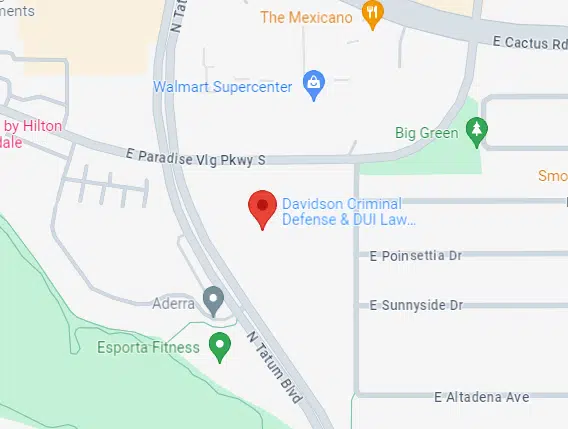
14362 N Frank Lloyd
Wright Blvd, Suite 1000,
Scottsdale, AZ 85260
Call (480) 248-7022
© 2026 Davidson Criminal Defense & DUI Law Firm• All Rights Reserved. Disclaimer | Site Map | Privacy Policy. Digital Marketing By: 
*Images are obtained under license from Canva and other third-party stock image providers, with attribution included where required.